
As AI writing tools become mainstream, one question keeps surfacing in classrooms, editorial offices, and corporate writing teams alike: what is an acceptable AI percentage? Whether you are a student submitting an essay to Turnitin or a content creator trying to pass GPTZero, understanding the thresholds — and how to work within them — has become an essential skill. This guide breaks down acceptable AI percentage benchmarks by context, explains how AI detectors calculate scores, and shows you actionable steps to bring your content into compliance.
Why the Acceptable AI Percentage Question Matters Now
The widespread adoption of ChatGPT, Claude, and similar tools has forced institutions to define boundaries. In 2024, Turnitin updated its reporting algorithm so that AI detection scores below 20% are no longer displayed numerically — they appear as an asterisk (*%). This change signals an implicit industry consensus: below 20% is generally considered a low-risk acceptable AI percentage for academic submissions. But "acceptable" is not universal. Publishers, employers, and professors each draw the line differently.
Understanding your specific environment's acceptable AI percentage is the first step. Getting below it — while keeping your writing sharp and authentic — is the second. Tools like AI Natural Write are designed to help writers achieve exactly that: preserving substance while lowering detectable AI signals.
Acceptable AI Percentage Benchmarks by Context
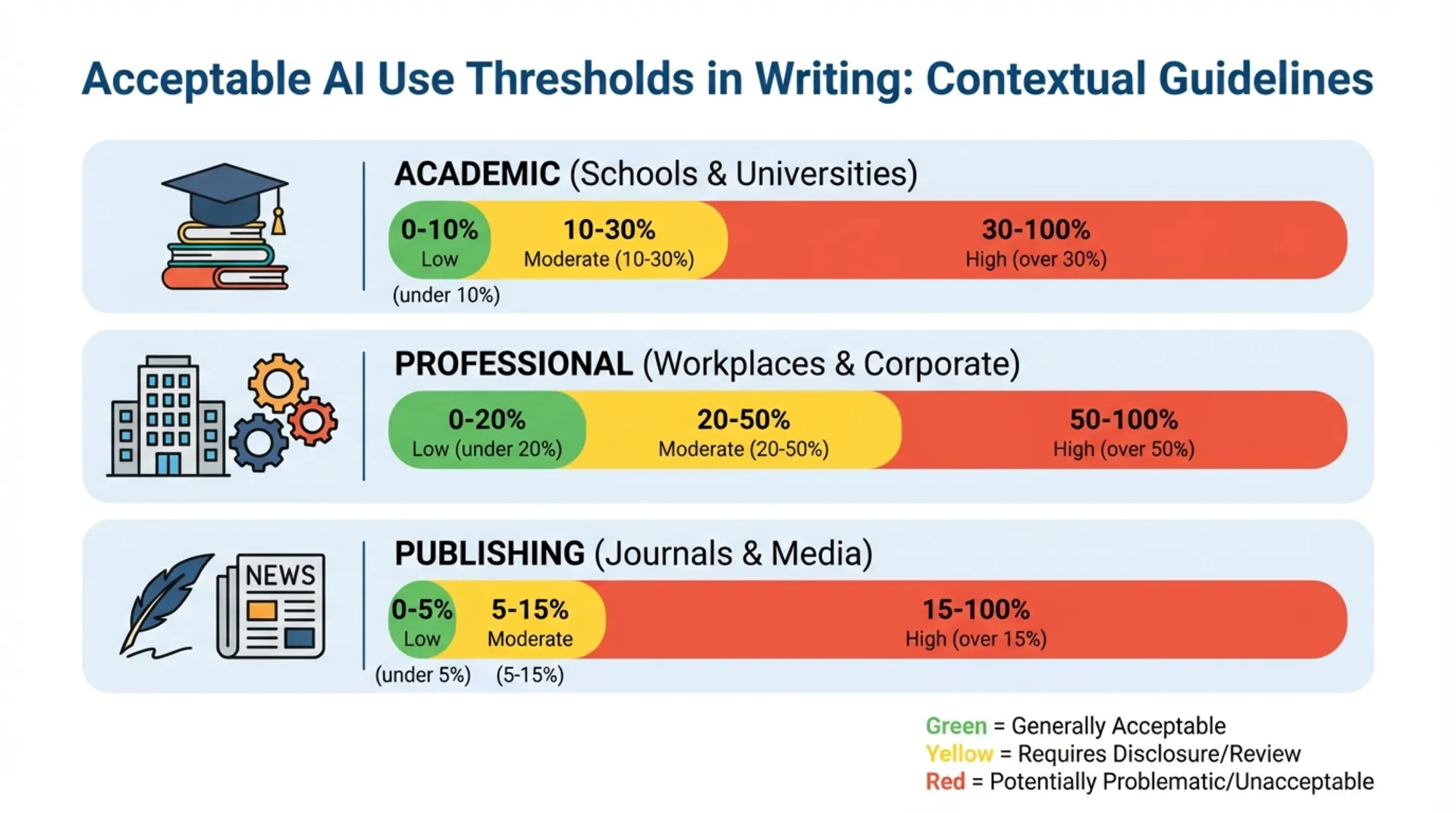
Academic Submissions (Schools and Universities)
Most universities have not set a hard acceptable AI percentage in writing policy yet, but common patterns are emerging:
- 0–10% AI detected: Widely considered safe. Turnitin does not flag this range numerically. Professors are unlikely to question the work.
- 10–20% AI detected: Generally viewed as minor assistance — comparable to using Grammarly or a thesaurus. This is still within the acceptable AI percentage range for most institutions.
- 20–50% AI detected: Raises scrutiny. Faculty may request a meeting or assign a follow-up oral assessment. This range sits above most acceptable AI percentage thresholds.
- 50%+ AI detected: High risk of academic misconduct proceedings at most institutions. Almost universally considered outside any acceptable AI percentage for student work.
Important caveat: AI detection scores are probabilistic, not deterministic. A score of 25% does not prove AI use — it signals a statistical likelihood. Always review your institution's specific policy on acceptable AI percentage before submitting.
Professional and Business Writing
In corporate environments, the acceptable AI percentage standard is more pragmatic. Many organizations allow — or even encourage — AI drafts, provided the final output reflects human judgment and brand voice. Common thresholds from content managers and editorial leads include:
- Under 30%: Generally acceptable for internal documents, emails, and reports.
- Under 20%: Recommended for client-facing or public-facing content.
- Under 10%: Required by some premium publishers and news outlets that have explicit acceptable AI percentage policies for submitted articles.
Content Marketing and SEO
Google's quality guidelines do not penalize AI-generated content per se, but they reward content that demonstrates Experience, Expertise, Authoritativeness, and Trustworthiness (E-E-A-T). From an SEO standpoint, the acceptable AI percentage for ranking competitive keywords is effectively determined by quality signals, not a raw detector score. That said, many SEO agencies now enforce an internal acceptable AI percentage cap of 15–20% on client deliverables to hedge against future algorithm changes and to satisfy editorial review.
How AI Detectors Calculate the AI Percentage
Understanding how your score is generated helps you bring it into the acceptable AI percentage range intentionally, not accidentally.
Tools like Turnitin, GPTZero, Originality.ai, and Copyleaks analyze text using a combination of:
- Perplexity: Measures how surprising each word choice is relative to likely language model predictions. AI tends to use predictable, low-perplexity phrasing.
- Burstiness: Measures variation in sentence complexity and length. Human writing bursts — some sentences are short and punchy, others sprawling. AI writing is often uniform.
- Entropy patterns: Statistical distribution of word choices across the whole document. AI models converge on common phrasing patterns that create recognizable entropy signatures.
When all three signals are high (predictable words, uniform sentences, repetitive entropy), the detector reports a high AI percentage — above the acceptable AI percentage range. To bring the score down, you need to disrupt these patterns without sacrificing readability.

7 Proven Strategies to Reach an Acceptable AI Percentage
1. Rewrite at the Sentence Level, Not Just Word-Swapping
Replacing synonyms is not enough. AI detectors focus on structural patterns. Break long compound sentences into shorter declarative ones, or merge short simple sentences into complex ones with subordinate clauses. This variation in sentence architecture raises burstiness and moves you closer to an acceptable AI percentage.
2. Inject First-Person Perspective and Personal Examples
AI-generated text rarely includes specific personal anecdotes, concrete dates, or named individuals. Adding a line like "When I tested this approach last September, the Turnitin score dropped from 38% to 11% after two revision passes" introduces content that no language model could have written — driving the detected percentage well below the acceptable AI percentage threshold.
3. Use an AI Humanizer Before Submission
Purpose-built tools are now available specifically for reducing AI detection scores. AI Natural Write is one such platform: it analyzes the perplexity and burstiness patterns in your draft and rewrites flagged segments to match human writing distributions. The goal is not to "cheat" a detector, but to ensure your AI-assisted draft meets the acceptable AI percentage standard your institution or client expects. Visit the AI Natural Write blog for more tips on writing naturally with AI assistance.
4. Read Aloud and Edit for Natural Rhythm
AI output often has a cadence that feels slightly too smooth — every transition is logical, every paragraph is balanced. Reading aloud reveals where the rhythm feels robotic. Trust those instincts: wherever something sounds too polished or generic, rewrite it in your own voice. This organic editing process is one of the simplest ways to lower your acceptable AI percentage score.
5. Add Domain-Specific Jargon, Idioms, and Local References
General-purpose language models struggle with hyper-specific terminology used by a niche community, regional expressions, or very recent events. Sprinkling these in naturally reduces the AI signal because the model's training data would not have contained such precise combinations.
6. Vary Paragraph Length Deliberately
One of the clearest AI fingerprints is consistent paragraph length — often 3–4 sentences per paragraph throughout. Break this pattern: write one-sentence paragraphs occasionally. Let a key point breathe on its own line. Then follow it with a longer block of analysis. This simple structural trick significantly disrupts entropy patterns and helps achieve an acceptable AI percentage.
7. Run Multiple Detector Checks Before Finalizing
Different detectors weight perplexity, burstiness, and entropy differently. A score of 8% on GPTZero might be 22% on Originality.ai for the same text. Run your draft through at least two detectors and revise until both fall within the acceptable AI percentage range for your context. Use the AI Natural Write detector tool as part of your workflow to benchmark your progress quickly.
What Turnitin's 2024 Policy Change Means for Acceptable AI Percentage
Turnitin's July 2024 update to suppress scores below 20% was a deliberate policy decision aimed at reducing false positives — cases where genuinely human-written text received a high AI percentage. The company acknowledged that its detector, like all current detectors, carries a margin of error. By not surfacing scores in the 0–19% range, Turnitin implicitly established 20% as the practical acceptable AI percentage floor for institutional concern.
However, this does not mean 19% is universally safe. Some professors have set stricter internal acceptable AI percentage standards — 10% or even 5%. Always check your course syllabus or assignment brief for explicit AI use policies before assuming the Turnitin threshold equals your institution's acceptable AI percentage.
Acceptable AI Percentage in Publishing: What Editors Look For
Literary magazines, academic journals, and content platforms each approach the acceptable AI percentage question differently:
- Literary publications: Many now explicitly state "no AI-generated submissions." In practice, they use detector scores as a screening tool and may reject work above 10%.
- Academic journals: Major publishers like Elsevier and Springer require disclosure of AI tool use. Some mandate that AI may only assist (grammar, formatting) and must not generate substantive content — implying a very low acceptable AI percentage for the core argument.
- Digital content platforms: Typically more lenient, but platforms like Medium and Substack have signaled they may downrank AI-heavy content. Keeping below a 20% acceptable AI percentage is a reasonable precaution.
FAQ: Acceptable AI Percentage
What is a safe acceptable AI percentage for Turnitin?
As of 2024, Turnitin does not display scores below 20%, treating that range as low-risk. Most educators consider 0–10% an unambiguously safe acceptable AI percentage. Between 10–20%, context matters — check your specific course policy.
Does a high AI percentage mean I cheated?
Not automatically. AI detection scores are probabilistic estimates, not proof. A score above the acceptable AI percentage threshold triggers review, not automatic punishment. You may be asked to explain your process or redo the assignment under supervised conditions.
Can human writing get flagged as AI?
Yes. False positives happen, particularly for writers with a formal, consistent style — non-native English speakers, technical writers, and scholars are especially vulnerable. This is another reason institutions treat acceptable AI percentage scores as one signal among many, not a verdict.
How do I lower my AI percentage quickly?
The fastest approach is to use an AI humanizer tool like AI Natural Write, which algorithmically rewrites AI-flagged segments to match human writing patterns. Combined with manual sentence restructuring and personal voice injection, most users can move from a 40%+ score into the acceptable AI percentage range within one or two revision cycles.
Is there a universal acceptable AI percentage standard?
No. Acceptable AI percentage standards are set by individual institutions, publishers, and employers. The most common practical threshold is under 20% for academic and professional use, but always verify the specific policy for your context.
What tools can help me stay within an acceptable AI percentage?
Several tools help: Turnitin (for academic submissions), GPTZero, Originality.ai, and Copyleaks for detection; and humanizers like AI Natural Write for rewriting. Using a detector and a humanizer together gives you a feedback loop to iteratively reach your target acceptable AI percentage.
Summary
The concept of an acceptable AI percentage is still evolving, but practical benchmarks are becoming clearer. For academic work, staying under 20% — ideally under 10% — is the safest target. For professional writing, under 20% is a widely adopted acceptable AI percentage for public-facing content. For publishing, policies vary widely and disclosure is increasingly required.
The key insight is that acceptable AI percentage is not just a compliance metric — it is a proxy for whether your writing reads as genuinely human. The strategies that lower your AI score (varied sentence structure, personal voice, specific examples, domain-specific language) are the same strategies that make writing compelling and credible. Use AI as a drafting accelerator, then invest the revision effort to bring the final product into your target acceptable AI percentage range. Tools like AI Natural Write make that revision process faster and more reliable, helping you produce content that is both efficient to create and authentically human to read.