
I used to think the problem was the model. You know the feeling: you paste a decent brief, hit generate, and the output comes back perfectly grammatical—and somehow still lifeless. It reads like it’s trying not to offend anyone. Too smooth. Too symmetrical. And if you’re running it through detectors, it can get flagged for exactly the same reason: it’s painfully predictable.
So here’s the twist I wish someone had told me earlier: if you want human-sounding output, you don’t just need a better draft. You need a better humanize AI prompt. The prompt should force the model into a messier, more human rhythm—and into more grounded, practitioner-style detail.
What “Humanize AI Prompt” Actually Means
“Humanize AI prompt” isn’t a gimmick and it’s not random paraphrasing. It’s a set of instructions that steer the model away from the default template voice and toward writing that feels like a person: uneven sentence length, specific context, real friction, and a point of view.
- It changes the shape of the writing: not just synonyms, but structure, rhythm, and emphasis.
- It adds constraints: audience, stakes, tradeoffs, and what not to claim.
- It forces specificity: concrete examples and practitioner language, not airy adjectives.
- It allows imperfection: a little texture, a little personality, a little “this is how I’d actually say it.”
If you’re publishing content, this is also a practical SEO issue. Readers bounce when the page feels generic. And search engines increasingly reward content that demonstrates experience and originality. (No magic tricks. Just better writing.)
Why AI Output Sounds Robotic (Even When It’s Correct)
Predictability (the “most likely” phrasing problem)
Most models default to phrases that are safe and statistically common. That’s why you get a lot of “in today’s world” and “it’s important to note” and “leverage.” Humans can be repetitive too—but not in that oddly consistent, professionalized way.
Symmetry (balanced paragraphs, mirrored transitions)
AI loves neat structure: intro, three points, conclusion. It’s clean. It’s also a fingerprint. Human writing tends to zig-zag: a short punch, then a longer thought, then a quick aside. The pulse changes.
Vagueness (generic claims instead of lived context)
The fastest way to sound like a template is to make claims with no anchor: “this is effective,” “this improves engagement,” “this is significant.” A human voice usually comes with little tells—a specific scenario, a frustration, an edge case, a tradeoff.
The Humanize-AI-Prompt Toolkit: 3 Copy-Paste Prompt Templates
Below are three prompt templates you can paste into any model. They’re designed to break the default rhythm and inject authentic detail. Pick the one that matches your situation, or stack them (carefully) for stronger results.
How to use these: paste your draft below the template, replace bracketed placeholders, and keep your source facts stable. Humanizing should not invent details.
1) Subjective Narrative & Sensory Details (first-person, lived texture)
Use this when the draft feels like a neutral summary and you want it to sound like someone who has actually been there.
Please rewrite the following content from a first-person perspective, transforming it from a neutral summary into a personal narrative. Avoid the standard "AI structure" that relies on balanced paragraphs and objective generalizations. Instead, incorporate subjective feelings, specific sensory details, and brief anecdotal snippets that "show" rather than "tell." Intentionally vary the sentence length—mix short, punchy observations with longer, more descriptive reflections to create a natural human rhythm. Use occasional rhetorical questions or light-hearted asides to engage the reader, making the tone sound like a real person sharing their authentic experience and unique point of view rather than a machine-generated report.

Content to rewrite:
[PASTE YOUR TEXT HERE]

Constraints:
- Keep all factual claims the same.
- If you add an example, make it a clearly labeled hypothetical.
- Remove buzzwords and repeated phrases.
2) Rhythmic Variation & Structural Deconstruction (break the template voice)
Use this when the writing is too evenly paced, too predictable, or packed with formal transitions. This one is all about burstiness.
Reconstruct the provided text to eliminate the rhythmic monotony and predictable patterns common in large language models. AI often produces sentences of similar length and uses a rigid "introduction-point-conclusion" template. Your task is to break this pattern by employing "burstiness"—a mix of very short sentences and complex, flowing clauses. Start the narrative in the middle of the action or with a bold statement instead of a generic opening. Replace formal transition words like "moreover" or "consequently" with more organic, conversational bridges or even abrupt shifts that mirror human thought processes. Ensure that each paragraph has a distinct "pulse" and avoids repetitive sentence-starting structures.

Text to reconstruct:
[PASTE YOUR TEXT HERE]

Do not:
- Add an H1.
- Use filler intros like "In today's world".
- Keep the same paragraph count if it hurts flow.
3) Semantic Nuance & Practical Context (sound like a practitioner)
Use this when the draft is technically correct but feels shallow. The goal is domain realism: concrete constraints, insider language, and honest tradeoffs.
Enhance the text by grounding it in specific, real-world context and nuanced vocabulary that reflects domain expertise rather than generic knowledge. Replace broad adjectives like "effective" or "significant" with precise, industry-specific terms or analogies that only a practitioner would use. Incorporate "insider perspective"—mentioning common frustrations, subtle industry nuances, or practical "hacks" that demonstrate lived experience. Avoid overly polished or perfect conclusions; human writing is often messy and leaves room for ambiguity or ongoing debate. The final output should sound authoritative yet accessible, mimicking the way an expert explains a complex concept to a colleague in an informal, coffee-shop setting.

Draft:
[PASTE YOUR TEXT HERE]

Context to include:
- Audience: [WHO IT'S FOR]
- Use case: [WHERE THIS WILL BE PUBLISHED]
- Constraints: [WORD COUNT, TONE, COMPLIANCE, ETC.]

Safety:
- Do not invent statistics, credentials, or real case studies.
A Simple Workflow: Prompt → Draft → Human Pass
A good humanize AI prompt gets you 70–80% of the way. The last part is still you (or your editor). Here’s a workflow that stays fast without publishing something that feels mass-produced.
- Pick one primary voice goal: narrative texture, rhythm, or practitioner depth. Don’t try to max all three on the first pass.
- Lock facts first: list the non-negotiables (names, numbers, claims). Humanization should not mutate truth.
- Generate two variants: ask for Version A (more conversational) and Version B (more concise). Then steal the best lines from each.
- Do a “read-aloud edit”: if you would never say a sentence out loud, rewrite it. Keep one or two imperfect, human turns of phrase.
- Run a quick sanity check: scan for repeated openers, repeated transitions, and generic claims.
If your workflow includes detector checks, treat them as signals, not judges. You can also point readers to your own tools when relevant (for example, an AI Detector page), but keep it natural.
Before/After: Humanizing With AI Natural Write
Sometimes you already have content—maybe it came from a model, maybe from a teammate—and you just need it to read like a person. That’s where a rewrite pass helps, especially when you want consistent tone across a whole site.
You can use AI Natural Write to rewrite AI drafts into more human-sounding text. The goal isn’t to scramble words. It’s to fix structure, rhythm, and specificity so the writing feels intentional.
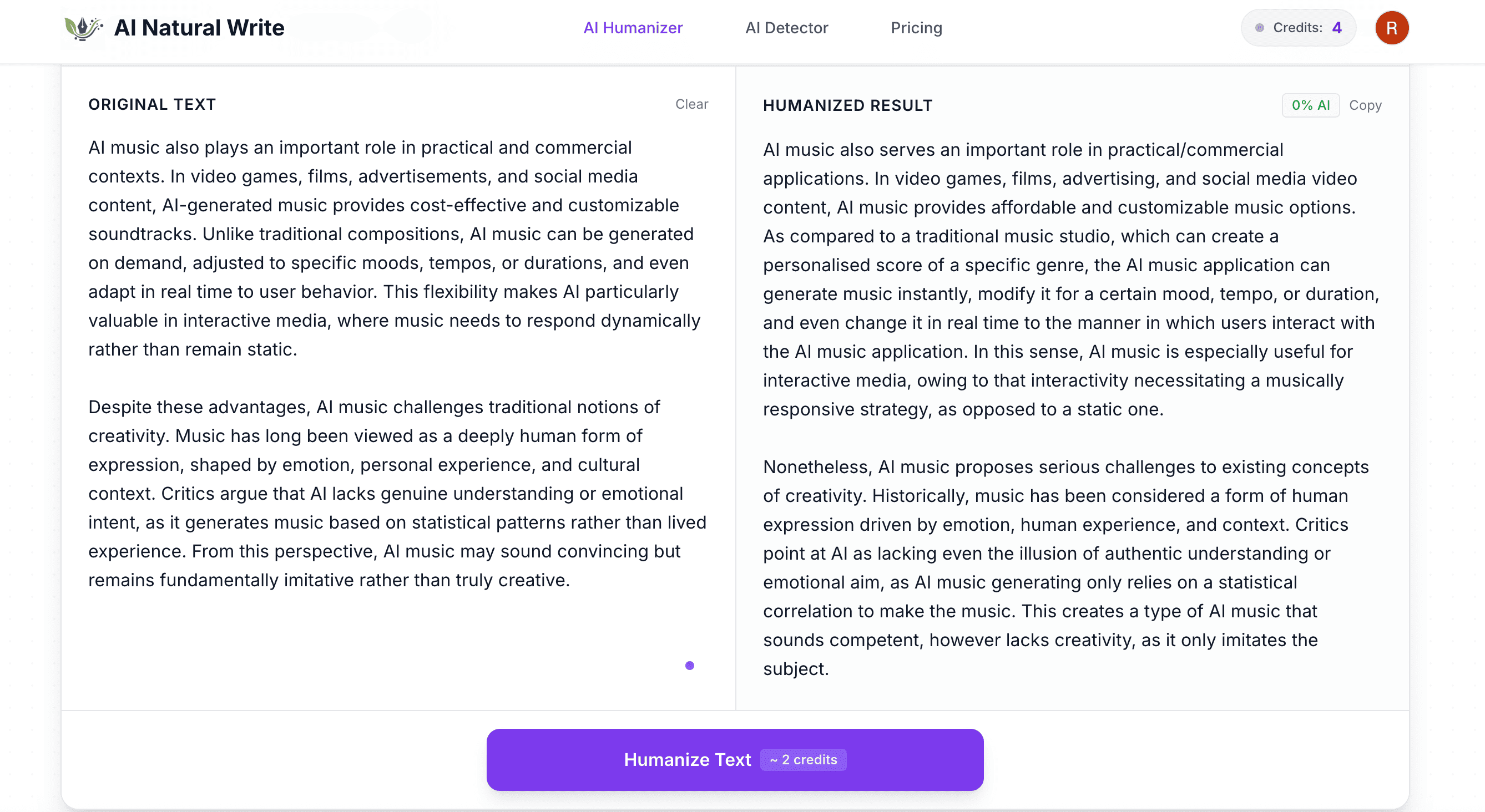
If you’re doing this at scale, pairing strong prompts with a consistent rewrite tool can save a lot of time. And if you’re deciding whether it’s worth it, check pricing and treat it like any other production tool: does it reduce editing time and improve readability?
Common Mistakes That Keep Your Prompt From Sounding Human
- Asking for “more human” without specifics: define what “human” means (first-person, sensory detail, shorter sentences, fewer transitions).
- Letting the model invent “real examples”: require hypotheticals unless you provide a true case study.
- Overstuffing instructions: too many constraints can produce stiff output. Pick one main objective per pass.
- Leaving the intro generic: the first 2–3 sentences are where template voice shows up fastest. Rewrite those manually if needed.
- Keeping the same paragraph pattern: break symmetry. Let one paragraph be a single sharp line if it earns it.
A small trick I like: after you get a decent draft, ask the model to highlight the three most “AI-ish” sentences and rewrite only those. It’s faster than rewriting everything and it trains your eye.
FAQ
Does a humanize AI prompt help with AI detection?
It can reduce obvious template signals (repetition, predictability, rigid structure). But detectors disagree and change often. Write for readers first, then treat detection scores as feedback, not a verdict.
Can I use these prompts with any model (ChatGPT, Claude, Gemini, etc.)?
Yes. The wording is model-agnostic. You may need to tweak length constraints or ask for two variants if a model tends to be verbose.
What does “burstiness” mean in writing?
It’s the natural variation in sentence length and structure: short punches mixed with longer, flowing clauses. Many AI drafts are too even, which feels robotic.
What if I need a consistent brand voice across dozens of pages?
Use a consistent prompt template and a consistent rewrite pass. Tools like AI Natural Write can help standardize tone while still sounding natural.
Summary
A strong humanize AI prompt doesn’t just ask for “better writing.” It forces the model into human rhythm, real-world context, and a point of view. Start with one of the three templates above, keep your facts stable, and do a quick human pass. If you want a faster production workflow, pair your prompts with a rewrite tool—and aim for natural write quality that feels like someone actually cared while writing it.