
If your draft looks "too smooth" and keeps getting flagged by AI detectors, you’re not alone. A natural writer approach focuses on human rhythm, real intent, and reader-first structure—so your writing sounds like a person, not a template.
What Does “Natural Writer” Mean?
“Natural writer” is not a single tool or a synonym swap. It’s a writing outcome: clear, varied, and human-sounding text that keeps the same meaning while improving flow and authenticity.
- Natural cadence: varied sentence length, punctuation, and paragraph rhythm.
- Human framing: a point of view, a purpose, and clear assumptions for the reader.
- Specificity: concrete examples, constraints, and non-generic claims.
- Consistency: stable facts, stable tone, and fewer repetitive patterns.
Why AI Detectors Flag AI Text (Even When It’s Correct)
Most AI detectors don’t truly verify authorship. They estimate whether the text matches statistical patterns common in LLM output. Common triggers include:
Perplexity and predictability
LLM drafts often sit in a narrow probability band (highly predictable phrasing). Human writing typically has more irregularity and surprise.
Burstiness and structure repetition
Humans naturally mix short and long sentences and shift structure. AI drafts can be uniform: similar openings, similar paragraph sizes, similar transitions.
Stylometry signals
Detectors look at function-word ratios, punctuation habits, and repeated phrasing. If your text reads like a polished template, it can be flagged.
Natural Writer Rewrite Checklist (Practical Steps)
Use this checklist on any AI draft to move toward a natural writer outcome while keeping meaning intact.
- Rewrite the first 2–3 sentences: remove generic hooks and replace them with the real problem + who it’s for.
- Break symmetry: vary sentence starters, sentence length, and paragraph size. Remove repeated patterns.
- Add constraints: specify scope (what you cover and what you don’t), assumptions, and audience context.
- Insert one real example: a mini case, a before/after, or a concrete scenario improves credibility and readability.
- Improve transitions: connect paragraphs using cause/effect, tradeoffs, or implications (not just “Additionally”).
- Do a human pass: read aloud, tighten awkward phrases, and add your genuine voice where it matters.
How AI Natural Write Helps You Write Like a Natural Writer
If you want a faster workflow, you can use AI Natural Write to rewrite AI drafts into more human-sounding text. The goal is not random paraphrasing—it’s structural rewriting that restores human variation and clarity.
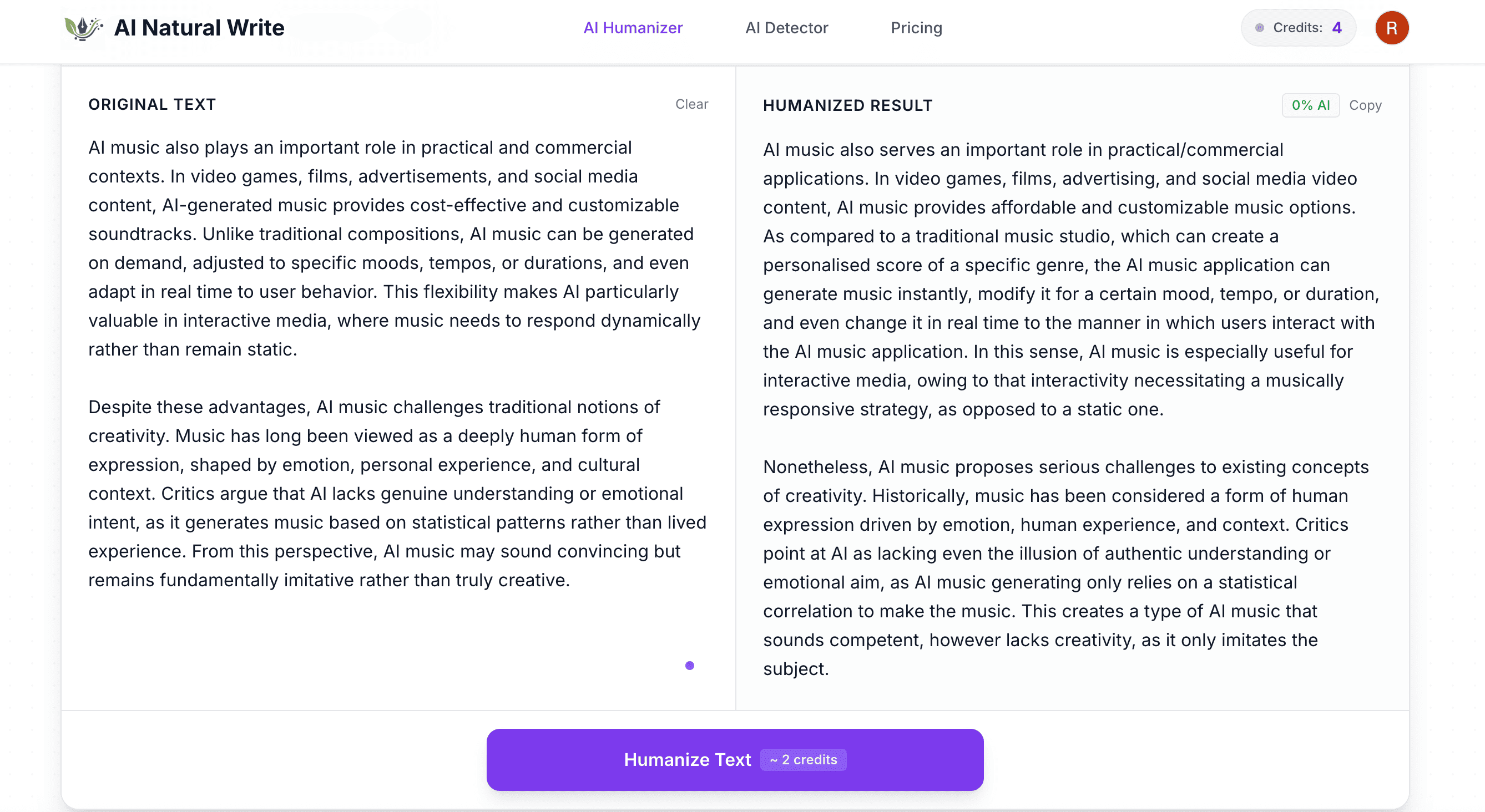
After rewriting, you can optionally test with multiple detectors (don’t rely on only one). If you also offer an AI detector page on your site, add an internal link such as AI Detector when relevant.
FAQ: Natural Writer and AI Detection
Will writing like a natural writer guarantee a low AI detection score?
No. Detectors change, disagree with each other, and can produce false positives. The goal is to make the content genuinely readable and human-sounding while reducing obvious AI footprints.
What is the biggest “giveaway” in AI-generated drafts?
Uniform structure and generic phrasing: repeated transitions, perfectly balanced paragraphs, and safe-but-vague wording that avoids specific claims or examples.
Is it safe to use AI rewriting for SEO content?
Yes if you keep intent, accuracy, and originality. Add your own examples, cite real facts where appropriate, and avoid publishing content you haven’t reviewed carefully.
Summary
A natural writer rewrite is about structure first: audience framing, human rhythm, specific examples, and authentic transitions. Use AI as a draft accelerator, then rewrite with intent—and tools like AI Natural Write can help you get there faster.