
College admissions have entered a new era where artificial intelligence plays a dual role: students use AI tools to enhance their writing, while admissions offices deploy sophisticated detection systems to identify AI-generated content. Understanding what AI detectors do colleges use for applications has become critical for students navigating the 2026 admissions cycle.
The Current State of AI Detection in College Admissions
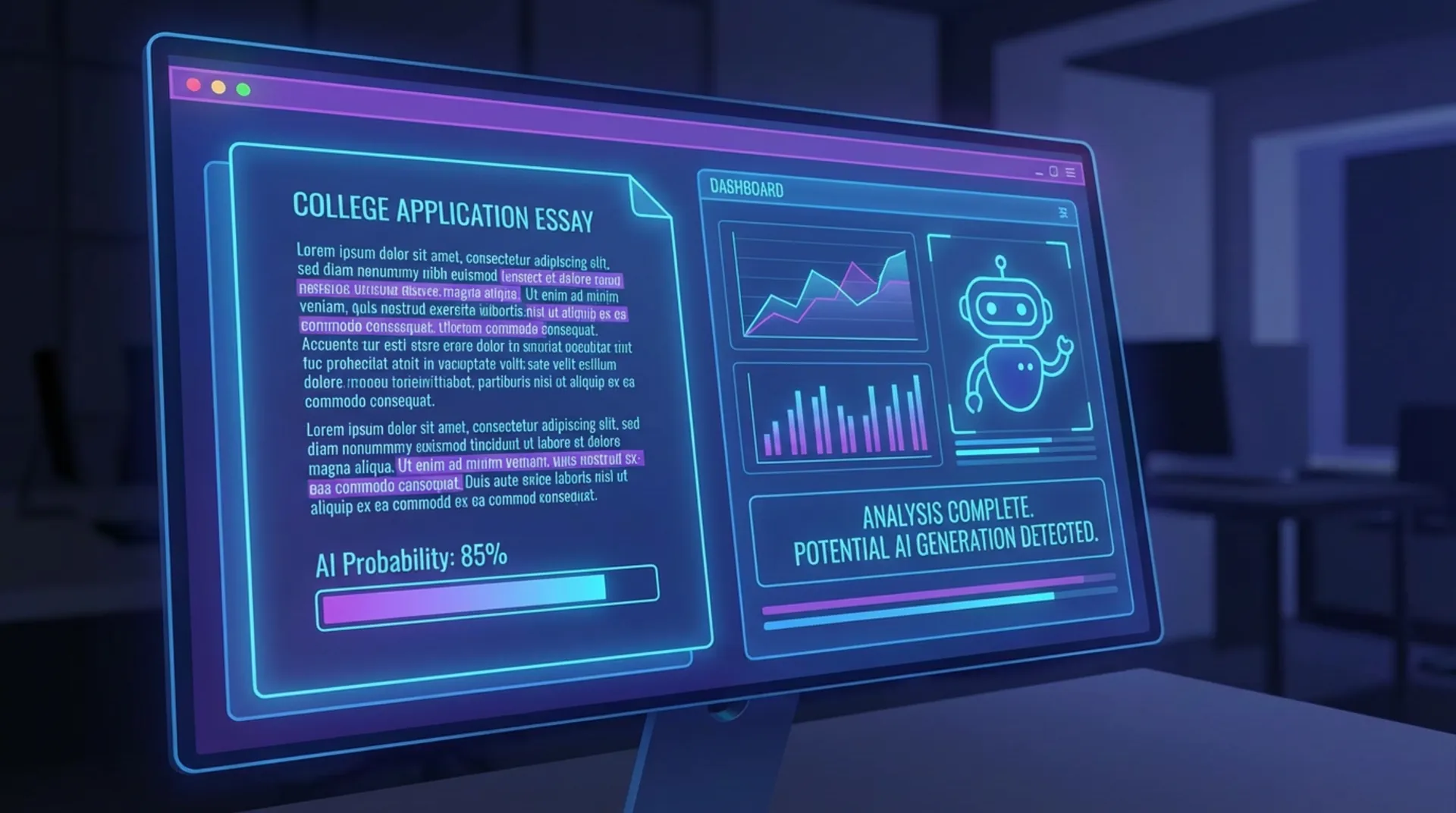
As of 2026, approximately 40% of four-year colleges actively use AI detection tools to screen application essays, a significant increase from 28% in early 2023. This adoption rate is projected to reach 65% by fall 2025, making AI detection a standard component of the admissions process at most institutions.
The Common Application, used by over 900 colleges, explicitly treats AI-generated content as application fraud. This policy shift has prompted admissions offices to invest heavily in detection technology, with some university systems spending millions on these tools.
Primary AI Detection Tools Used by Colleges
When examining what AI detectors do colleges use for applications, three platforms dominate the landscape:
Turnitin AI Detection
Turnitin remains the market leader, with the California State University system alone spending $1.1 million on the platform in 2025. However, Turnitin's AI detector has faced significant accuracy concerns. The system exhibits a 4% sentence-level false positive rate, meaning one in every 25 sentences may be incorrectly flagged as AI-generated. For documents under 300 words—typical of many supplemental essays—Turnitin acknowledges "higher-than-comfortable" false positive rates.
More troubling, ESL writers and non-native English speakers are flagged at rates 2-3 times higher than native speakers, with false positive rates approaching 9.24% for this demographic. These accuracy issues have led prestigious institutions like Johns Hopkins and Vanderbilt University to disable Turnitin's AI detection features entirely.
GPTZero
GPTZero has gained traction in admissions offices as an alternative to Turnitin. While generally more accurate for shorter texts, GPTZero still reports a 10.02% false negative rate, meaning it fails to detect AI-generated content in roughly one out of ten cases. Despite these limitations, many colleges appreciate GPTZero's user-friendly interface and lower cost structure.
Copyleaks and Proprietary Systems
Copyleaks focuses primarily on academic integrity for coursework but is increasingly deployed for admissions screening. Additionally, some universities have developed proprietary detection systems tailored to their specific needs. Pangram Labs, for instance, claims 99.85% accuracy with only a 0.032% false positive rate, though independent verification of these claims remains limited.
How AI Detection Technology Works
Understanding what AI detectors do colleges use for applications requires knowing how these systems analyze text. Detection algorithms examine three primary patterns:
Perplexity Analysis: This measures how predictable each word is given the preceding context. AI-generated text tends to follow more predictable patterns, while human writing exhibits greater variability and unexpected word choices.
Burstiness Patterns: Human writers naturally vary sentence length and complexity, creating "bursts" of different writing styles. AI systems typically produce more uniform sentence structures, lacking the natural rhythm of human composition.
Vocabulary Distribution: AI models favor certain words and phrases based on their training data. Detection systems track these frequency patterns to identify machine-generated content.

Beyond Software: What Admissions Officers Notice
While technology plays a significant role in answering what AI detectors do colleges use for applications, human reviewers remain the final arbiters. Admissions officers who read thousands of essays annually develop intuition for detecting AI-generated content through:
- Generic language lacking specific personal details
- Unnatural voice that doesn't match the applicant's background
- Predictable structure and transitions
- Inconsistencies between the essay and interview responses
Many selective colleges conduct interviews specifically to verify that students can speak naturally about their written work. If an applicant cannot articulate ideas from their essay or discuss their writing process, this raises immediate red flags.
Consequences of AI Detection in Applications
The stakes for using AI in college applications extend beyond simple rejection. Consequences may include:
- Immediate application disqualification
- Notification to other colleges through shared databases
- Potential rescission of admission offers if detected post-acceptance
- Long-term impact on academic integrity records
Even when AI-generated essays evade detection, they often fail to achieve their intended purpose. Generic, AI-produced content lacks the authentic voice and specific details that make applications memorable, ultimately reducing admission chances.
Writing Authentic Essays in the AI Era
Students can write compelling essays without triggering detection systems by focusing on authenticity. Tools like AI Natural Write can help refine human-written content while preserving your unique voice, rather than generating text from scratch.
Key strategies include:
- Start with personal experiences and specific anecdotes
- Use your natural vocabulary and sentence structures
- Include details only you would know
- Vary sentence length and complexity naturally
- Have trusted mentors review for authenticity
Frequently Asked Questions
Do all colleges check application essays for AI?
No, but the majority do. Current data shows 40% of four-year colleges actively use AI detection, with adoption expected to reach 65% by fall 2025. Even colleges without automated detection train admissions officers to recognize AI-generated content.
Can AI detectors make mistakes?
Yes, significantly. Turnitin's 4% false positive rate means legitimate human writing is sometimes flagged. Non-native English speakers face even higher false positive rates approaching 9.24%. This is why many colleges use detection tools as one factor among many, not as definitive proof.
What happens if my essay is flagged as AI-generated?
Colleges typically conduct additional review before making decisions. You may be asked to provide drafts, discuss your writing process, or complete a timed writing sample. False positives can usually be resolved through this verification process.
Is it okay to use AI for brainstorming or editing?
Policies vary by institution. Most colleges accept AI use for brainstorming ideas or grammar checking, similar to using a thesaurus or spell-checker. However, having AI generate substantial portions of your essay typically violates policies. Always check specific college guidelines.
How can I ensure my essay won't be flagged?
Write authentically from your own experiences using your natural voice. Include specific details, personal reflections, and genuine insights. If you use AI tools for editing, ensure the final product still sounds like you and reflects your actual experiences.
Conclusion
Understanding what AI detectors do colleges use for applications is essential for navigating modern admissions. While Turnitin, GPTZero, and Copyleaks dominate the detection landscape, the most effective safeguard remains writing authentic, personal essays that reflect your genuine experiences and voice. As detection technology evolves alongside AI writing tools, the timeless value of authentic storytelling becomes even more critical for admission success.